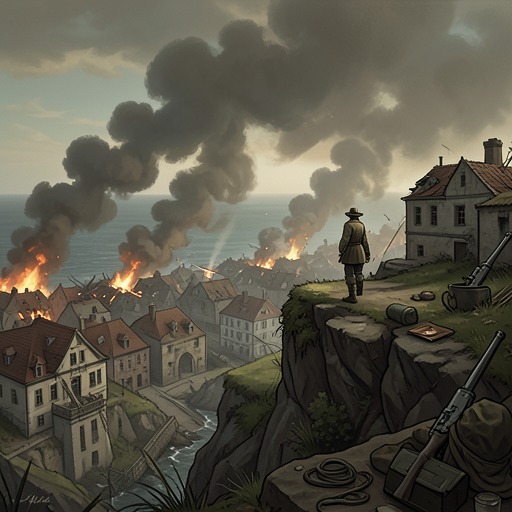
Madame Manec
All the Light We Cannot SeeMadame Manec is the practical caretaker at the heart of the household in Saint-Malo: she receives Marie-Laure LeBlanc and Daniel LeBlanc as displaced newcomers, sustains Marie-Laure through the demands of occupation and illness, and helps organize resistance among local women. Her care is never merely private. Food, shelter, guidance through the city, and the work of resisting German authority grow from the same readiness to take responsibility for other people.
Identity and Introduction
When Daniel announces his daughter at the door, Madame Manec reacts with astonishment and immediate concern. She cups Marie-Laure’s cheek with a strong hand, notices her worn stockings and heels, and asks whether she is famished. Her physical presence is sharply drawn: she seems short, wears heavy, blocky shoes, and speaks in a low, rough voice compared to a sailor’s or a smoker’s. The fairy-tale lilt in her speech sits beside an unmistakable briskness; surprise gives way quickly to action.
She ushers the visitors into a narrow entry, shuts and secures the door with dead bolts and a chain, and takes them to the kitchen. There, the practical sequence of welcome—chair, warm towel, sweet water, and a meal—answers the exhaustion of their journey. As Daniel recounts their flight, Madame Manec cooks an omelet with eggs, spinach, and melting cheese. For Marie-Laure, who cannot see the meal, its steam and smells make the welcome immediate and tangible. Madame Manec’s hospitality is expressed through things made and done, not ceremony.
Her first account of the town widens that welcome into a picture of its hardship. Saint-Malo is crowded; many newcomers are sleeping on straw in warehouses and do not have enough to eat. Fuel is scarce, and the British ships have gone. Madame Manec would take in more people, she says, but worries that doing so might upset Etienne LeBlanc. She also notes that Etienne keeps the wireless going. Her remarks establish both the shortage surrounding the household and the anxious, politically charged world into which Marie-Laure has arrived.
Care within the Household
Madame Manec becomes a steady source of practical care as Marie-Laure adjusts to the house. When the girl wakes and ventures into the unfamiliar rooms, Madame Manec climbs the narrow flights to find her, takes her by the hand, and guides her back to bed. She checks what she needs, tells her that Daniel has gone into town to try the telegraph office, and asks whether she is hungry. Her care makes a difficult, confusing house temporarily navigable without pretending that its occupants know what will happen next.
She also makes room for pleasure and ordinary comfort amid uncertainty. When Etienne alternates between reading to Marie-Laure and shutting himself away in his study with a headache, Madame Manec gives the girl chocolate, cake, and glasses of sweetened lemon water. She does not erase Etienne’s periods of withdrawal or promise that they will be brief: sometimes he is secluded for a day or two, sometimes longer. Instead, she supplies companionship and small treats while Marie-Laure waits.
Her attentiveness extends beyond the house. One early morning she leads Marie-Laure into the streets, reassuring her that hardly anyone is out and that they are doing nothing wrong. In light rain, along cobbles that catch and vibrate beneath the cane, Marie-Laure experiences the city as a maze of sound and unfamiliar turns. Madame Manec steers her through it, including a turn Marie-Laure does not expect toward a gateway in the moss-covered city walls. The outing is an act of guidance and trust: Madame does not leave the girl to face the strange streets alone, but helps her encounter them directly.
From Care to Resistance
Madame Manec’s political resolve emerges from the ordinary work that connects the town. In the kitchen, after the women discuss the absurdities of occupation-era taxes and prices, she deadbolts the door and addresses those gathered. She points out that their labor keeps the occupiers’ systems functioning: Madame Guiboux’s son repairs their shoes, Madame Hébrard and her daughter sort their mail, and Madame Ruelle’s bakery makes much of their bread. The recognition changes the conversation from complaint to a question of what these women can do with the position they already occupy.
Her own actions give that argument a practical shape. Madame Ruelle and Madame Guiboux strap a stepladder to a car and travel at dusk along the Route de Carentan to rearrange road signs with a ratchet set. They return to the kitchen at Number 4 rue Vauborel laughing and drunk; Madame Ruelle reports that Dinan is now twenty kilometers to the north, then jokes that it is in the middle of the sea. The episode presents resistance as local, improvised work undertaken by women who know the roads and can interfere with the occupiers’ use of them.
Madame Manec also presses Etienne to act rather than retreat into fear. She argues with him in his study while Marie-Laure listens near the doorway, and insists, “Don’t you want to be alive before you die?” Her challenge does not make the danger disappear: Etienne answers that Marie-Laure is almost fourteen and that children die in war too, while admitting that he wants fourteen to remain young. Madame Manec’s position is not a denial of risk but a refusal to let fear become the only rule for living.
At the Hôtel-Dieu, she and Marie-Laure wait amid talk of U-boats, currency, and marine engines. Madame orders bowls of chowder; when she still does not know what to do next, she orders two more. In conversation with René, she adopts the name Madame Walter and chooses another name for herself: “I think I would like to be the Blade.” The pseudonyms and the Blade’s sharp, purposeful image belong to the clandestine atmosphere of their work. They also suit the decisive voice that elsewhere refuses passivity.
Illness, Death, and Lasting Consequences
During a damp Breton spring, Madame Manec falls ill with pneumonia. Marie-Laure feels heat rising from her chest, and the illness brings prolonged, oceanic coughing. Etienne summons a doctor, who prescribes rest, aspirin, and violet comfits; Marie-Laure sits with Madame through the worst hours, when her hands turn very cold. Even in delirium, Madame imagines herself responsible for everything: every newborn infant, falling leaf, breaking wave, and ant on its journey. The scale of this imagined burden enlarges a quality already present in her daily conduct. She has treated care as an obligation extending outward, from the person in front of her to a whole living world.
Madame Manec dies, and the loss becomes part of Marie-Laure’s understanding of what has been taken from her. Later, when a German pursues the story of the hidden stone, Marie-Laure swallows the pulped remains of a paper and angrily lists what her father’s departure has left her: a model of the town, a broken promise, her dead Madame, and a frightened great-uncle. The outburst reveals how inseparable Madame’s protection had become from the girl’s sense of home. She is not remembered as an abstraction or a distant symbol of courage, but as someone whose absence has left Marie-Laure more exposed.
Her care and resistance also remain legible in the people and routines around her. Before Madame’s death, she helps Etienne through the terror of going outside; much later, when he finally manages to leave the house, the memory of the attacks that once drove him back to his bed includes Madame helping him home. The novel gives her an enduring significance through these concrete acts: she feeds people, guides a blind child through the city, challenges a frightened man, and joins women who quietly disrupt occupation. Her courage is built into the ordinary labor of keeping others alive and making action possible.